
 800-570-3355
 The Best Energy Saving Appliances Under the Inflation Reduction Act
Induction Cooktops, Air Conditioners, and Heat Pump Dryers qualify for energy-saving government rebates.
It’s an ideal time to upgrade your home appliances with energy-saving products. Our appliance experts handpicked their top choices in multiple categories for the kitchen and laundry room. As of August 12, 2022, The Inflation Reduction Act, will offer new consumer benefits for energy-saving home appliances including induction cooktops, wall ovens, and heat pump dryers.
AjMadison offers over 150 top choice brands that homeowners may wish to consider when ordering new appliances to take advantage of this energy savings initiative. This legislation includes $4.5 billion for states to provide rebates for the purchase of new electric appliances, including ranges, cooktops, wall ovens, and heat pump dryers. The Department of Energy will allocate funds to individual states. Each state will choose how to use the funds, sticking to the parameters set forth for income requirements and caps on individual rebates.
The exact terms of the rebates will be decided at the state level. The Inflation Reduction Act does provide a rough framework such as a homeowner could receive a rebate of up to $840 on a new electric cooking appliance and up to an additional $500 to help cover the costs of converting from natural gas or propane to electric. If the home’s electrical panel needs upgrading to accommodate an electric range (or any other electric appliance upgrade covered by the Inflation Reduction Act, such as certain electric heat pumps or electric-heat-pump clothes dryers), consumers are eligible for a tax credit of up to $4,000 for that expense as well.
Next to professional gas cooktops and ranges, electric induction is a top choice contender. Consumers are choosing to update with induction for its cleanability, safety, speed, and efficiency. Year to date, induction sales are up 35 percent, and in the last three weeks, since the announcement of The Inflation Reduction Act, induction sales are up another 20 percent and heat pump dryer sales are up 75 percent.
“I shock so many people with my love for induction because as a pro chef most people automatically think I am going to love gas ranges more." States Culinary Educator, Recipe Writer and Food Content Creator, Saba Wahid, who was the 2020 winner of Chopped: Martha Rules Grand Champion
“I love cooking, but I hate cleaning. So, when I am at home, I want to have a smooth and efficient surface. I also love the precision of induction, going from zero to boil in 90 seconds is incredible. And being able to sear a steak or hold sauces and soups at potentially a warm plate function, with gas you still cannot get as low as you can with induction. Induction has so many incredible benefits and a lot of people are switching.”
Safer, planet friendly with easy cleanup and installation:
Induction is the fastest-growing cooking technology in the United States. AjMadison anticipates that the demand for induction will increase in the future as more consumers are learning about the benefits of this innovative technology. With induction, there is an electromagnetic reaction between the burner and the pot or pan itself. If there is no pot or pan on the burner, just turning the burner on will not generate any heat, safer for young children, aging family members and pets. Within a few minutes of turning off an induction burner, both the pan and the burner become cooler quickly, making burns less likely. The key to making an induction cooktop or range work is to use a specific magnetic pot or pan to generate the electromagnetic reaction to cook the food. Typically, this will mean using cast iron or magnetic stainless steel. An easy test is to take a refrigerator magnet and hold it up to a pot and pan. If it sticks, the pan should work on an induction cooking surface.
For large kitchens where home cooks can share the space, AjMadison recommends a 36-inch cooktop paired with a double wall oven, steam oven, microwave drawer, or even a pizza oven. In a medium or small-size kitchen, ranges are the top choice. Most buyers choose induction ranges as they are budget-friendly and can easily replace an older electric range.
Since induction cooking is faster than traditional stovetop cooking, it also uses less energy. It generates less residual heat (any heat will be in the pot or pan and not coming from the stovetop itself). This makes for less energy usage and lower electric bills. Induction also requires less ventilation, so it is a great solution for city dwellers, or homes where venting outside is not possible.
Furthermore, induction cooktops are smart. If the appliance senses a boil over, most will turn off automatically, and induction heats the cookware, not the glass. This means that the glass is far less likely to cause cooking burns. Cleanup is also easier. The glass cooktop requires only a wipe down and since the stove stays relatively cool throughout, food seldom sticks to it.
Plus, induction cooktops and ranges are easy to install. If one has an old electric range, it can be replaced with an induction model. Just make sure to check the specifications to ensure the electrical breaker has enough amps. Induction cooktops come in all shapes and sizes and can make a terrific addition to a guest suite, pool house, in-law apartment, or even a home office.
Induction cooktops are different than radiant electric cooktops. With regular electric cooktops, a heating coil under the cooking surface heats the glass which heats the pan, so the glass becomes scorching hot. If one spills on a radiant electric cooktop, burnt circles result over time which can be difficult to clean. Induction is different in that the inductors cause the pan to heat up, not the glass. Although the glass under the cookware will be quite warm, one is less likely to experience those hard-to-clean messes. This means the induction range or cooktop will look brand new for years to come. One can wipe the induction surface after cooking, with a damp cloth or paper towel. For an even easier clean-up, one can place a towel under the cookware to catch splatter.
See all Induction Ranges and Induction Cooktops
Looking into the Laundry Room with Heat Pump Dryers that fit the bill for energy efficiency:
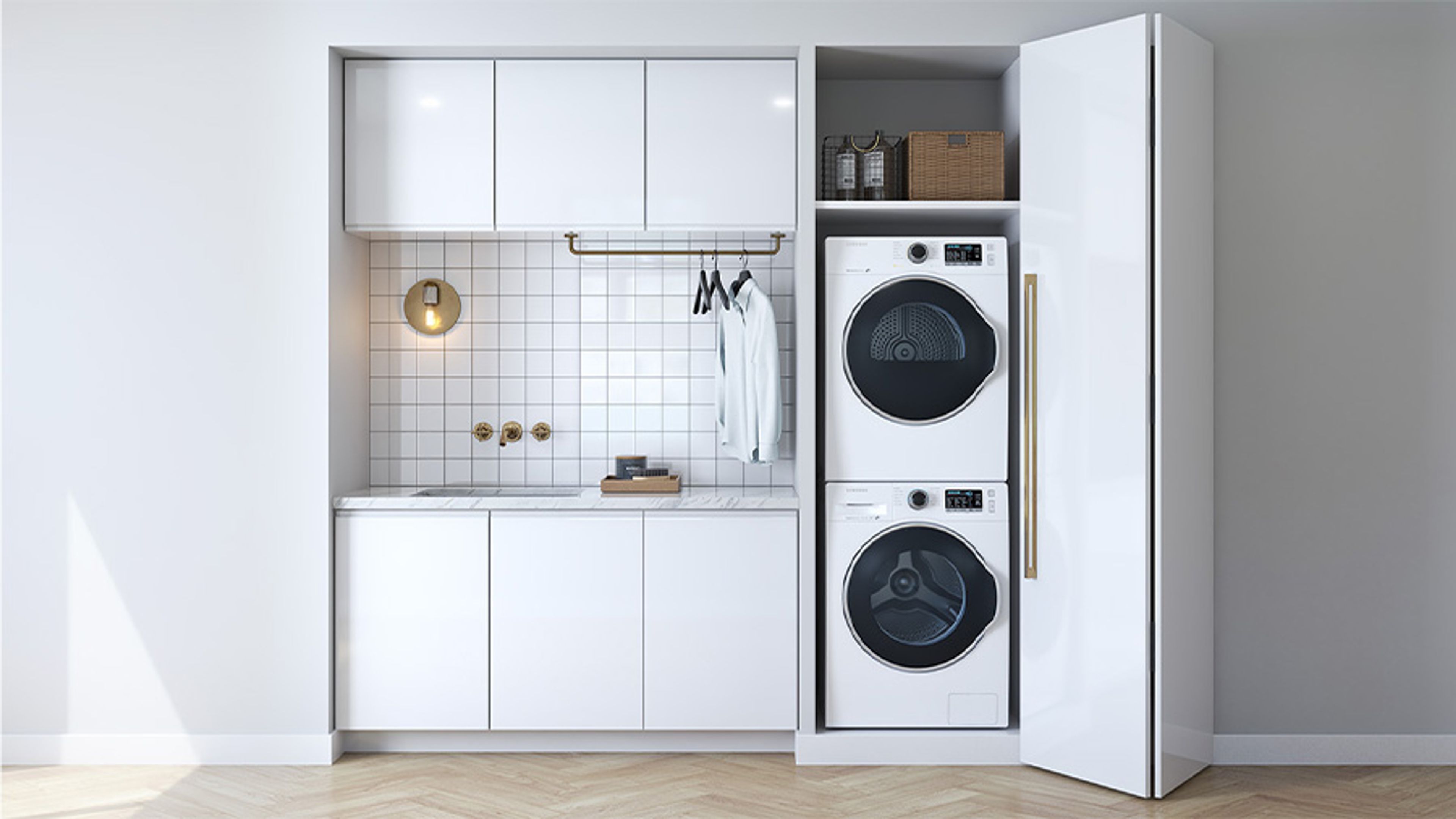
Space-saving washers and dryers deliver innovative performance in a small space design. Adding a small space washer and dryer is perfect for city apartments, primary suites, and guest houses. Think creatively by adding washer and dryer sets to multiple parts of the home for guest privacy/convenience. Small space sets are available in three dryer types: vented, ventless condensation, and ventless heat pump. Heat Pump Dryer Technology is the most eco-friendly available using half the energy of traditional vented dryers saving both the environment and utility costs. Ventless washer dryer sets make it possible to add a washer-dryer set where venting outside is impossible. Here are our top picks for Heat Pump dryers:
Stay Comfortable and Cool with Heat Pump AC Units that fit the bill for energy efficiency:
Today’s air conditioners are durable and high-performing, yet quiet. They come in various sizes with many convenient features, including trendy color panels to match your room. Start here to learn the basics about air conditioners designed to keep you cool when the weather gets hot.
Mini-split air conditioners are a compact and efficient solution for providing cooling and often heating to your home. Used throughout Europe and Japan for decades, these systems are gaining popularity in the U.S. for their quiet operation and versatile applications.
Unlike most Window AC units, mini-split models can provide not only cooling but heating as well. This can be a versatile option for heating on a room-by-room basis, or it can be used home-wide as an energy-efficient alternative to a traditional heating system.
Most mini-split systems include responsive technology to provide energy efficiency that other AC systems cannot. Window units and central air systems are most often limited to only two settings – “Off” or “On.” This can contribute to excessively hot or cool environments. In contrast, the inverter compressor technology in mini-split systems enables the compressor to adjust its motor speed based on higher or lower energy demand. This variable usage both conserves energy over time and eliminates the energy lost during a traditional AC system’s startup.
When a mini-split system operates in heating mode, it’s using electricity to simply move heat rather than create heat. As a result, mini-splits use significantly less energy than electric heaters and other traditional systems.
Share this article: